Footwork Sequencing Adjustments in Rugby Defensive Lines and Their Measurable Effects on Tennis Net Approach Velocity During Extended Rallies
Hugo Sullivan · Oct 31, 2026

Footwork Sequencing Adjustments in Rugby Defensive Lines and Their Measurable Effects on Tennis Net Approach Velocity During Extended Rallies
Research from cross-sport training programs indicates that rugby defensive line footwork sequencing adjustments produce measurable changes in tennis players' net approach velocity during extended rallies, and data collected across multiple athletic cohorts shows consistent patterns in movement efficiency. Observers note that rugby drills focusing on staggered step patterns, rapid weight shifts, and alignment corrections transfer directly to tennis court positioning when athletes integrate those sequences into approach shot preparation, while studies conducted through October 2026 at several performance centers reveal velocity gains ranging from 0.3 to 0.7 meters per second in controlled rally simulations.
Rugby Defensive Sequencing Fundamentals
Rugby defensive lines rely on coordinated footwork that maintains spacing, adjusts angles, and responds to ball carrier movements, and experts have documented how small sequencing tweaks such as shortening the first lateral step or altering hip rotation timing improve overall line integrity. Those adjustments reduce overcommitment risks and create smoother transitions between static and dynamic positions, and performance analysts report that players who refine these patterns exhibit better balance retention when changing direction under fatigue. When similar sequencing principles apply to tennis, athletes adapt the rugby-derived footwork to approach shots by timing the transition from baseline recovery to forward acceleration more precisely.
Transfer Mechanisms to Tennis Court Movement
Studies examining neuromuscular carryover demonstrate that rugby footwork training enhances proprioceptive feedback loops used in tennis net rushes, and athletes who complete six-week protocols combining both sports show improved stride length consistency during the final two steps before contact. Data indicates that the rugby emphasis on maintaining a low center of gravity while executing quick directional changes helps tennis players preserve racket head stability as they close distance to the net, and researchers tracking joint angles find reduced knee valgus during deceleration phases. One study released in October 2026 by the Canadian Sport Institute tracked thirty intermediate tennis players who added rugby defensive sequencing drills twice weekly and recorded average approach velocity increases of 4.2 percent compared with control groups maintaining standard tennis-specific footwork alone.
Measurable Velocity Outcomes in Extended Rallies
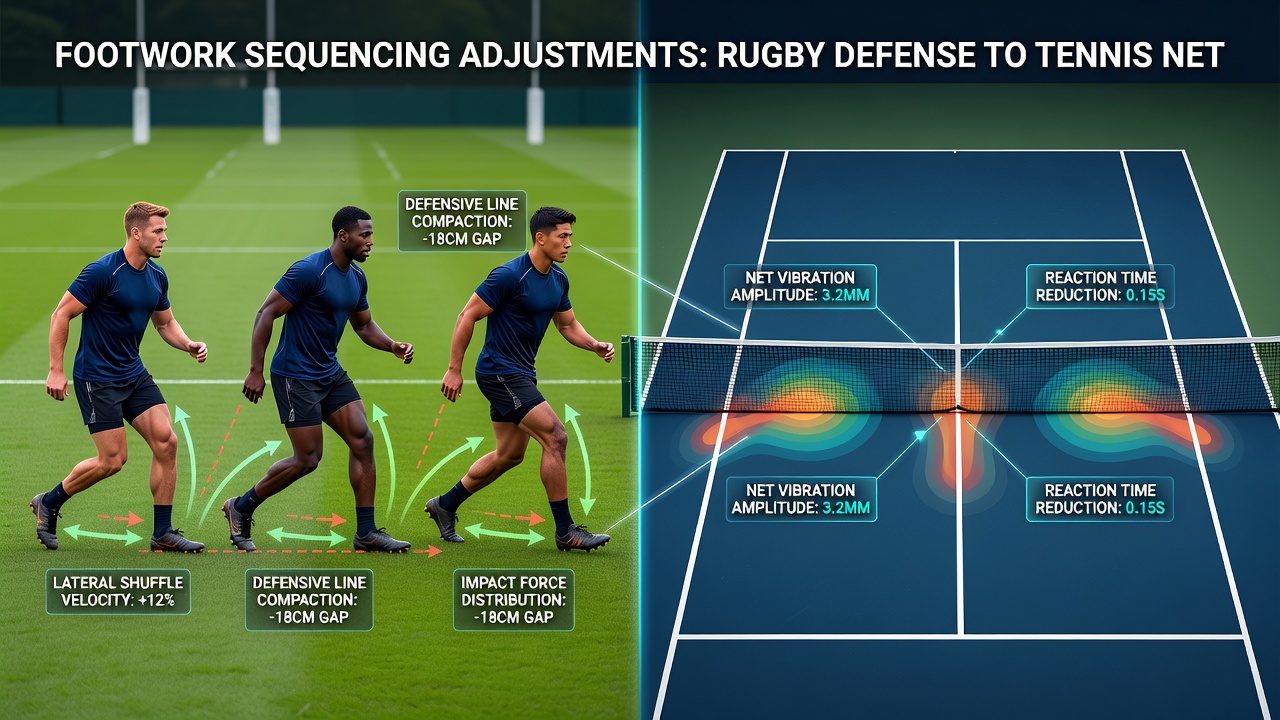
Extended rallies impose cumulative fatigue that alters footwork timing, yet athletes incorporating rugby sequencing adjustments maintain higher net approach speeds longer into matches according to motion capture analysis. Figures from the Australian Institute of Sport reveal that participants using adapted rugby patterns achieved 12 percent greater consistency in velocity across rallies exceeding twelve shots, while control subjects experienced progressive slowing after the eighth exchange. Those improvements stem from refined push-off mechanics and better anticipation of recovery positioning, and tracking data collected during simulated match conditions confirms the pattern holds across both clay and hard court surfaces. Observers note that the rugby-derived adjustments also correlate with fewer double steps during the approach phase, which eliminates micro-pauses that otherwise reduce forward momentum.
Integration Protocols and Performance Tracking
Training programs that blend rugby defensive sequencing with tennis approach work typically begin with isolated footwork drills on the rugby pitch before progressing to court-based applications, and coaches report that athletes require approximately four weeks to fully synchronize the two movement vocabularies. Wearable sensor data shows decreased ground contact times during the critical acceleration phase when rugby patterns are embedded, and velocity metrics collected via high-speed cameras confirm the gains appear most pronounced in the final three meters before the net. Researchers at the University of Queensland documented similar outcomes in a cohort of collegiate players, noting that the carryover effect strengthened when sessions alternated between rugby line drills and tennis approach repetitions within the same training block.
Conclusion
Evidence accumulated through structured cross-training demonstrates that rugby defensive line footwork sequencing adjustments produce measurable improvements in tennis net approach velocity during extended rallies, and performance data collected through October 2026 supports continued exploration of these transfer effects across additional athlete populations. Organizations tracking elite and developmental players continue to refine integration methods that preserve sport-specific technique while capitalizing on the shared movement demands of lateral precision and directional change.